Freud and Psychoanalysis
- Creator of psychoanalysis
-Talk between patient laying on couch, and a doctor
- Convinced everything was sexually linked
- The Interpretation of Dreams
-Dreams result of sexual repression
- Thought, feelings, volition - unconscious mind
- Sexual impulses are important as potential causes of mental illness, artistic and cultural creation
- Existence of subconscious evident because of every day mistakes, reports of dreams, symptoms of neurosis
- Oedipus Complex - infantile sexuality
-Oral (pleasure gained from mouth), Anal and Phallic (touching genitals) stages
-Boys attracted to mother and jealous of father, start becoming more like them to steal mother
-He was sure there was a feminine equivalent but never quite worked it out
-The Ego and the Id
-The mental apparatus = id: repository of instinctual impulses
ego: influence of external world
superego: develops from id, dominates ego, represents inhibitions of
instincts that are characteristics of man
-All three need to be in harmony or mental disorders will develop
The Freudian Unconscious
- Most of our mental life is unconscious
- Slip of tongue is a better guide to someone's intentions
- Dreams are always fulfilment of repressed fantasies
- Examination of neurotic symptoms
-Austrian bloke, too fat, tries to slim, wards off love rival
-Id: unconscious locus of love and hunger
-Ego: reason and common sense
-Superego: observes, judges and punishes ego
Thursday, 29 November 2012

Wednesday, 21 November 2012
So.
My blog has somehow passed the 10,000 view count. So I thought I was relatively qualified to come up with a list of how to get your blog more views:
1) Set it as your homepage
2) Set it as your parents' homepage
3) Set it as your sibling's homepage
4) Tell them that tabs don't work and that they have to open a new page every time they want a new site
5) Sit back and watch the magic happen
6) Oh, and write a few things every now and then. Readerships and all that...
1) Set it as your homepage
2) Set it as your parents' homepage
3) Set it as your sibling's homepage
4) Tell them that tabs don't work and that they have to open a new page every time they want a new site
5) Sit back and watch the magic happen
6) Oh, and write a few things every now and then. Readerships and all that...
Tuesday, 13 November 2012
Philosophy in the Modern World - Chapter Notes: 9 & 10
CHAPTER 9
Bentham
"Nature has placed mankind under the governance of two sovereigns - pain and pleasure."
Maximise happiness = Maximising pleasure
Pleasure is a sensation - eating, drinking, sex, wealth, kindness to animals, belief in Super Being
Quantification of pleasure and pain - Utilitarianism - The greatest happiness for the greatest number - Democracy
Principle of asceticism - Approving of actions to the extent that it diminishes happiness
- Can't be pursued by a living creature - why chase something that's bad for you?
Principle of sympathy and antipathy - judges things as good or bad in accordance with own feelings
- Moral sense & Common sense
John Stuart Mill
Foolish to deny that people have desires and pleasures greater than animals
Happiness = Contentment and dignity
Difference between what is moral and what is just
Difference between justice and moral rights - legal rights can be unjust and just claims can conflict with the law
Equality - "Everybody to count for one, nobody for more than one" shares with Bentham
Schopenhauer
Will is not affected by birth and death
It is only a phenomenon that one individual is distinct from another
Will is a thing in itself and is separate from nature and human nature, which is a necessity
The only way to escape will is renunciation - Reduce egoism - the idea that you are the centre of everything and the world revolves around you
Kierkegaard
The ascetic person is deluded to think their existence is one of freedom, it is limited
A despairing person is someone who has no hope higher than what they have in their current life
Self - creating your own characteristics. Aesthete's are always in a state of pregnancy, waiting to give birth to their new 'self'
Nietzsche
Master morality - noble birth, bravery, candour, blondness
Slave morality - humility, sympathy, benevolence, the underdog
Transvaluation of Values ^^^^^ - blamed on the Jew - revolt of the slaves was successful
'The weak and failures shall perish: that is the first principle of our love of man kind" - Antichrist
Ascending and Descending people - only Nietzsche could tell who was who
Supermen - Highest form of life, Will to live (power)
Humanity is a stage on the way to the Supermen - "Man is a bridge and not a goal"
Doing away with yourself almost earns you the right to live
Analytic Ethics
G. E. Moore
Highly values goodness
Goodness - not a natural property but could be a property of natural things
R. M. Hare
Make room in ethics for Logic - Moral reasoning
Value statements - 'Good boy' etc - Giving something (object or person) a label of quality
Philippa Foot
A judgement cannot be treated as a moral judgement because of universalisability and prescriptivity - cannot make actions 'good' or judge someone with red hair as 'good'. Everyone has different opinions on matters of what's good or bad. Good for me could be bad for you.
CHAPTER 10
Aesthetics of Schopenhauer
Art influences desire, which influences will
Disinterested Contemplation liberates us from tyranny - scene absorbs attention without effort - beauty
- threatening scene - sublime
Kierkegaard on Music
Aesthetic people devote their life to seeking immediate pleasures
Music expresses sheer sensuality - most abstract of arts
Nietzsche on Tragedy
Origin of art is to cheer up humans and tell misery where to go
Apollo and Dionysus
Monday, 12 November 2012
How to - Zoom into Images
Images in news reports are boring - they don't move. But there are ways round this and because I've had a few people ask how to do it, I'm tapping up this little 'how to' blog.
Zooming into still pictures gives them more life and keeps them in line with the rest of the piece as everything keeps moving.
To start with you want to a picture and drag and drop it into Final Cut Pro. I've chosen one of my dog as a puppy. You want to make it last about 15 seconds for the sake of this tutorial.

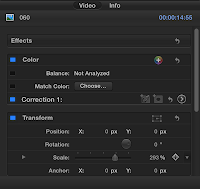 Now, as you can see the image isn't the right size, but that shouldn't matter because you can zoom in on it if you don't want the whole thing in shot. To do this you click on the image in the timeline to select it. You then take your curser to the box in the top right corner of your window where it should say 'Video' and 'Info'. Select 'Video' then use then find the scale slider. Move this left and right to zoom in and out.

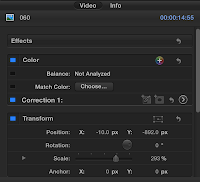 Your image is now zoomed in but this may not be the section you want to focus on. To change the position of the image stay in the same box, but instead of adjusting the scale select 'Position' instead. The X axis moves your image left and right whereas the Y axis will move it up and down. You can adjust these values until the image is in the position you want it to be in.
 Now you know the basics we can move on to the next part of the tutorial, the bit that makes everything 'move' - Keyframes.
To start with you want to take the 'Playhead' (the line that moves along your video's timeline as it plays) and place it at the start of the image. Adjust the Position and Scale values to what you want it to look like before it starts to zoom in. I'm going with the default settings: Scale - 100%, Position - X: 0 Y: 0.

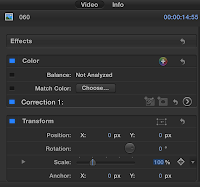 When you place your mouse over the values you will see a plus sign appear in a diamond to the right hand-side of the adjusters. Click this on both the Position and Scale values to lock them in place. They will turn yellow once they are set.
You then want to move the playhead further along the image to where you want the image to start zooming in. Don't change any of the values, just click the diamonds again to set the position. Ideally it should be around the two second mark.

Now you have to move the playhead to where you want the image to stop zooming in, around four seconds from the end of it so that the viewer has time to take it in.

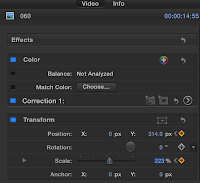 Return to the Position and scale sliders and adjust them to how you want the final zoomed in image to look, then press the diamonds again to set the keyframes.
When you watch the video it should now zoom in on the image, jazzing it up a little bit.

Zooming into still pictures gives them more life and keeps them in line with the rest of the piece as everything keeps moving.
To start with you want to a picture and drag and drop it into Final Cut Pro. I've chosen one of my dog as a puppy. You want to make it last about 15 seconds for the sake of this tutorial.

 Now, as you can see the image isn't the right size, but that shouldn't matter because you can zoom in on it if you don't want the whole thing in shot. To do this you click on the image in the timeline to select it. You then take your curser to the box in the top right corner of your window where it should say 'Video' and 'Info'. Select 'Video' then use then find the scale slider. Move this left and right to zoom in and out.
 Your image is now zoomed in but this may not be the section you want to focus on. To change the position of the image stay in the same box, but instead of adjusting the scale select 'Position' instead. The X axis moves your image left and right whereas the Y axis will move it up and down. You can adjust these values until the image is in the position you want it to be in.
To start with you want to take the 'Playhead' (the line that moves along your video's timeline as it plays) and place it at the start of the image. Adjust the Position and Scale values to what you want it to look like before it starts to zoom in. I'm going with the default settings: Scale - 100%, Position - X: 0 Y: 0.

 When you place your mouse over the values you will see a plus sign appear in a diamond to the right hand-side of the adjusters. Click this on both the Position and Scale values to lock them in place. They will turn yellow once they are set.
You then want to move the playhead further along the image to where you want the image to start zooming in. Don't change any of the values, just click the diamonds again to set the position. Ideally it should be around the two second mark.

Now you have to move the playhead to where you want the image to stop zooming in, around four seconds from the end of it so that the viewer has time to take it in.

 Return to the Position and scale sliders and adjust them to how you want the final zoomed in image to look, then press the diamonds again to set the keyframes.
When you watch the video it should now zoom in on the image, jazzing it up a little bit.

You can also use this technique to rotate the images (Rotation) and apply them to video files.
Monday, 22 October 2012
FA Cup Fourth Qualifying Round - AFC Totton 2 - 3 Cambridge City
AFC Totton crashed out of the FA Cup at the hands of Cambridge City, the final hurdle before the league clubs became involved.
 The visitors started brightly, opening the scoring after just two minutes. An out-swinging corner found David Theobald, whose thundering header crashed the underside of the crossbar before hitting the back of the net.
Totton pressed for an equaliser and they eventually got it. After scoring a hat-trick on Tuesday, Mike Gosney got on the end of Dave Allen's cross, heading past the sprawling keeper at the far post.
The Stags looked in control until City scored against the run of play. Totton couldn't scramble a cross clear and were made to pay when Adrian Cambridge connected with a superb 20 yard volley on 36 minutes.
Mike Gosney wasted a chance to put the hosts level, his free kick was poorly struck and didn't make it past the defence.
An equaliser never looked likely, Totton's long ball game was easily tamed by City's sturdy defence, and their dominance was rewarded after 60 minutes, David Prada hit a fantastic curling shot into the top corner, giving Barfoot no chance.
Dave Allen pulled one back for Totton - his volley hit the ground before bouncing over City's keeper. It proved to only be a consolation goal and when the final whistle went it was Cambridge and their fans celebrating. The magic of the FA Cup lives on within them as they welcome MK Dons in the First Round proper.
 The visitors started brightly, opening the scoring after just two minutes. An out-swinging corner found David Theobald, whose thundering header crashed the underside of the crossbar before hitting the back of the net.
Totton pressed for an equaliser and they eventually got it. After scoring a hat-trick on Tuesday, Mike Gosney got on the end of Dave Allen's cross, heading past the sprawling keeper at the far post.
The Stags looked in control until City scored against the run of play. Totton couldn't scramble a cross clear and were made to pay when Adrian Cambridge connected with a superb 20 yard volley on 36 minutes.
Mike Gosney wasted a chance to put the hosts level, his free kick was poorly struck and didn't make it past the defence.
An equaliser never looked likely, Totton's long ball game was easily tamed by City's sturdy defence, and their dominance was rewarded after 60 minutes, David Prada hit a fantastic curling shot into the top corner, giving Barfoot no chance.
Dave Allen pulled one back for Totton - his volley hit the ground before bouncing over City's keeper. It proved to only be a consolation goal and when the final whistle went it was Cambridge and their fans celebrating. The magic of the FA Cup lives on within them as they welcome MK Dons in the First Round proper.
Wednesday, 17 October 2012
Seminar Paper - Karl Popper and Logical Positivism
One of the main aims of the Vienna Circle was to lay down universal philosophical statements that are true and clarify which statements aren't philosophical and are false. This school of thought is known as 'Logical Positivism.' To do this they would take empirical statements such as 'everybody dies' which are records of experience and verify them using the verification principle. The verification principle is the idea that for something to be true it has to be verifiable with proof, the scientific method. For example 'everyone dies' has been learnt through experience, so far there hasn't been a case where someone hasn't died. This is the protocol that the idea is based on, although it is not impossible for it to be falsified. Opponents of this view-point say that statements are true to individuals, but to avoid solipsism Schlick said that so long as two people can agree on the definitions of words they can have a discussion using the language of science. If two people are arguing over what a trike is, but can agree that 'tri' means three then they can have a discussion.
Descartes is a victim of the verification principle, along with other Romanticists. His famous statement 'I think therefore I am' does not make sense and is tossed aside by logical positivists. Their argument? That you cannot verify that you exist by thinking. This is a sensible approach; by not taking anything at face value Logical Positivists extinguish any statements that can't be proven, leaving us with what they see as the bare facts about the world. These include necessary truths which are truths that are necessary for our understand of our surroundings, but don't tell you anything new. All triangles have three sides isn't exactly enlightening, it's just a truth that exists everywhere in the universe.
The verification principle itself raises some questions; is it a tautology? Was it verifiable by experience?In other words, was it its own worst enemy?
As for the first question it doesn't seem to be. It doesn't leave results as plainly obvious as 'all beginners are just starting,' instead it proves statements to be correct using the scientific method. It creates its own answers, rather than repeating itself. Whether it is verifiable by experience is a different matter, who's to say that the truths that it produces are correct? For years Aristotle's heliocentric theories were taught as facts in the top universities around the world, but over time this has been proven false. We currently study physics alongside Einstein's Laws of Relativity which states that nothing can travel faster than the speed of light, but even this has been questioned recently. If we can't verify what is true, how can the verification principle be verified itself?
Karl Popper attempted to answer this question by dismissing the verification process and replacing it with a falsification process. He argues that by falsifying theories with the scientific method we can eventually whittle our way down to the truth. This is a pain-stakingly long process, but one that has been in on-going for centuries. Ideas are there to be disproven, first it was Aristotle, then it was Francis Bacon. Einstein may be next.
But that's not to say that Popper thought that history was teleological and we would end up with absolute truths about everything. He believed that ideas would continue to be falsified and that we would never come to a final conclusion - history may be going somewhere but there was no definitive end that other theories such as Marx's idea of Communism being the light at the end of the tunnel suggested.
As part of the falsification process Popper answers questions that Hume's use of induction poses. He states that science assumes that nature is like the past and things that happened in the past will happen time and time again. This is called induction, but induction itself is not scientific. It begins with an idea and then experiments take control of whether it is true or not. Einstein, he says, allowed people to test his theory of relativity, by doing this he opened his idea for criticism. If his test passed the experiments the theory stood strong, however, if it fails any tests it is immediately falsified and cast aside. So long as I don't float up at any moment, Newton's theory of gravity stands as correct, but it is always being tested.
What is important about Popper is that he understood that everything is potentially untrue. Nothing is unfalsifiable. There will always be something out there, whether it be on a distant star or in the distant future, nothing is certain.
Descartes is a victim of the verification principle, along with other Romanticists. His famous statement 'I think therefore I am' does not make sense and is tossed aside by logical positivists. Their argument? That you cannot verify that you exist by thinking. This is a sensible approach; by not taking anything at face value Logical Positivists extinguish any statements that can't be proven, leaving us with what they see as the bare facts about the world. These include necessary truths which are truths that are necessary for our understand of our surroundings, but don't tell you anything new. All triangles have three sides isn't exactly enlightening, it's just a truth that exists everywhere in the universe.
The verification principle itself raises some questions; is it a tautology? Was it verifiable by experience?In other words, was it its own worst enemy?
As for the first question it doesn't seem to be. It doesn't leave results as plainly obvious as 'all beginners are just starting,' instead it proves statements to be correct using the scientific method. It creates its own answers, rather than repeating itself. Whether it is verifiable by experience is a different matter, who's to say that the truths that it produces are correct? For years Aristotle's heliocentric theories were taught as facts in the top universities around the world, but over time this has been proven false. We currently study physics alongside Einstein's Laws of Relativity which states that nothing can travel faster than the speed of light, but even this has been questioned recently. If we can't verify what is true, how can the verification principle be verified itself?
Karl Popper attempted to answer this question by dismissing the verification process and replacing it with a falsification process. He argues that by falsifying theories with the scientific method we can eventually whittle our way down to the truth. This is a pain-stakingly long process, but one that has been in on-going for centuries. Ideas are there to be disproven, first it was Aristotle, then it was Francis Bacon. Einstein may be next.
But that's not to say that Popper thought that history was teleological and we would end up with absolute truths about everything. He believed that ideas would continue to be falsified and that we would never come to a final conclusion - history may be going somewhere but there was no definitive end that other theories such as Marx's idea of Communism being the light at the end of the tunnel suggested.
As part of the falsification process Popper answers questions that Hume's use of induction poses. He states that science assumes that nature is like the past and things that happened in the past will happen time and time again. This is called induction, but induction itself is not scientific. It begins with an idea and then experiments take control of whether it is true or not. Einstein, he says, allowed people to test his theory of relativity, by doing this he opened his idea for criticism. If his test passed the experiments the theory stood strong, however, if it fails any tests it is immediately falsified and cast aside. So long as I don't float up at any moment, Newton's theory of gravity stands as correct, but it is always being tested.
What is important about Popper is that he understood that everything is potentially untrue. Nothing is unfalsifiable. There will always be something out there, whether it be on a distant star or in the distant future, nothing is certain.
Wednesday, 10 October 2012
AFC Totton 3 - 2 Merthyr Town
Despite the close score-line, AFC Totton made light work of
swooping their Welsh counterparts aside in a thrilling encounter at the
Testwood Stadium.
 Totton started bright, forcing a few smart saves out of Town
keeper Giles Cutlan before Jonathan Davies’ in-swinging corner appeared to
evade everybody in the box to creep in at the near post. Although Davies
claimed the goal, the ball seemed to get a touch off the out-stretched leg of
Merthyr’s skipper, Steve Williams.
Totton started bright, forcing a few smart saves out of Town
keeper Giles Cutlan before Jonathan Davies’ in-swinging corner appeared to
evade everybody in the box to creep in at the near post. Although Davies
claimed the goal, the ball seemed to get a touch off the out-stretched leg of
Merthyr’s skipper, Steve Williams.
Richard Gillespie added his 17th goal of the
season in all competitions with a powerful strike from 18 yards, having
out-muscled a defender to run on to Dave Allen’s chipped pass.
Allen later found himself on the score sheet after Gillespie
squared the ball past the keeper, gifting the midfielder with the simple chance
of walking the ball into the net to make it 3-0 before the break.
Totton didn’t hold back after the break either, with Mike
Gosney finishing a tantalising run by striking the ball directly at Town’s
keeper, and then Richard Gillespie knocked down another long ball, only to find
his shot blocked by Cutlan’s legs.
Merthyr gave their supporters something to cheer shortly
afterwards. A string of passes found Ryan Prosser on his own in the six yard
box and the number 9 could barely miss as his shot rasped over Gareth Barfoot
into the net.
The Totton keeper was caught napping on 90 minutes, but
Jamie Rewbury’s lob proved nothing more than a consolation goal as the final
whistle blew after kick off.
Totton face Cambridge City at home in the next round.
Subscribe to:
Posts (Atom)